Saying YES to the Writer Inside You

Maya Angelou said, “There is no greater agony than bearing an untold story inside you.”

I don’t know about that. I’ve had some bigger agonies in my life than that.

HOWEVER, after several years of burying an untold story inside me, I’ve decided to take some concentrated time to get the story on paper.

Halting Progress

I started this novel five years ago. I have started and stopped this novel so many times I’ve lost count. I still love it, but it’s one of those novels that isn’t commercial (no Amish vampires), isn’t a series, and isn’t edgy. But I love it. It stays with me every time I pause to write a series for someone, or teach a workshop, or critique a novel, or write a work-for-hire book for an educational publisher.

My novel is languishing half finished, and I’ve decided to take the time to finish it now. Three months of study and writing time is going to be my gift…to ME!

Changes

What will that mean? Several things. For three months (until August 1): 

  • I won’t be writing new blog posts. If you’re looking for help, there are hundreds of blog posts available here on all kinds of topics. (See the list down the right-hand side.)
  • I won’t be doing novel critiques for three months.
  • I won’t be available for guest blog posts, online interviews, or teaching a workshop.
I’ve been writing lately about retreats, but I decided I needed more. It’s like a sabbatical, time away from activities that can burn you out, then taking that time and energy and pouring into your work. I’m excited about the coming months! See you back here August 1!

Let's All Say "Ahhhhhhhh…" and Retreat!

Even when life is going well, the writing pressures, the marketing, the waiting, and the deadlines can make you dream of taking a writing retreat. Add in too many volunteer activities, caring for a baby, taking elderly parents to all their doctors’ appointments, and some days you want to run away.

Last week I mentioned a “book in a box” called The Writer’s Retreat Kit: A Guide for Creative Exploration and Personal Expression by Judy Reeves. I’ve looked longingly at it several times and read some of her ideas of creating writer’s retreats lasting from twenty minutes to several days, depending on the time and money you have available.

Madly Treading Water

This time, though, I’m not going to sigh and put the book box back. I’m going to delve deeper into the retreat idea and try some of the experiences. It’s no surprise that I’m as tired as I am–it’s been months since I could take a weekend (or one day) truly “off.” When I read the following opening page, I let out a big Ahhhhhh! I bet some of you will too. Judy writes:

Getting away: the wish and dream and fantasy of every writer I have ever known and, I expect, of nearly every writer I will ever meet, except for those rare and blessed souls who are lucky enough, or determined enough, or rich enough, to already be “away.”

What is “away”? It is someplace else. It is the place that each of us craves, and when we close our eyes, comes to us in all its wooded shadiness or vast, unending blueness. We visualize a mountain cabin; a cottage by the sea; a secret, hidden monastery; a wide-decked, win­dowed, pillowed, sweet-smelling, abundant, nurturing, solitary place where there are no “musts” or “have tos” or “shoulds.” No dishes to do or phones to answer or children/mates/partners with whom we must interact. No set time to start or stop, to wake up or go to sleep. No television. No email. No deadlines. No place to drive to. It is sim­ply a place to be.

“Away” is generally where we long to be as we arm wrestle the elements of our daily lives to make time for our writing and for that private and soulful part of us that we long to be with but so often set aside.

Getting Rid of False Guilt

It is not that we don’t love our lives; we do. Mostly. And we love the people in our lives — family and friends — and the work we do that allows us to afford the lives we mostly love. But sometimes it’s a little too much for a little too long.

What we want is to get away for a little while. We don’t want to just go on vacation, but to a place we go alone, or maybe with a few like-minded souls who also want to be alone, but in an alone/together way. To renew and refresh and explore and create and refill. To retreat. And to write.

A writing retreat.

Maybe it will be a place you rent. Maybe it will be a free picnic table in a park. Maybe it will be your own backyard swing.

The inner pressure is building. I’m about ready to run!

"They Say…" Writing Advice

I hope you new writers question everything “they say” you have to do to succeed. That includes any advice I might give on this blog.

Thirty years ago “they said” a new writer had to find a way to get to New York and meet the editors face to face if she wanted to sell a book. I had four small children and couldn’t afford that, but still got in “over the transom” to be fished out of the slush pile. I didn’t meet my editor face to face until I had done seven novels with her–and someone else paid for a business trip to NY.

Over thirty years, I’ve had 44 books published by various traditional publishers. Today “they say” you must attend conferences to meet editors face to face and increase  your chances of selling to them. I have met some lovely editors and agents at conferences I both attended and spoke at. I’ve paid for critiques with some of them. However, I’ve never sold anything that way.

Don’t Get Me Wrong

I’m not saying to avoid conferences or trips or critique groups or social networking or anything else “they say” you must do to succeed. There is some wisdom in all that advice. But does it all apply to YOU? No one else can tell you that.

This week I am taking some time to re-think a few writerly things I’ve been doing that “they say” are so important for writers to succeed in the digital age. Some things I will keep doing. Some, I suspect, I will drop.

Real Writing Advice

Some writerly advice never changes though. If you want some wise advice for writing success, read Rules for Writing and Life” by Jane Resh Thomas.

Retreat Time: Is It Possible?

While recovering from an illness I picked up simply (I believe) from being exhausted, I was going through my favorite writing books.

One caught my eye and created an instant longing: The Writer’s Retreat Kit: A Guide for Creative Exploration and Personal Expression by Judy Reeves. It’s like a writer’s retreat in a box, with ideas for one-hour retreats, half-day retreats, weekend retreats and longer. They can be retreats at home or far away.

Retreat: a Definition

Among other things, the author wrote:

A writing retreat isn’t just about the time spent writing. Perhaps equally important as the time spent writing is the time given over to nourishment… For many writers, a retreat is a time for reconnecting with nature, for long walks in quiet woods or beside a restless seashore, for rowing on a lake or canoeing on a river. We long for a soundtrack of birdsong or trickling creek, for the lazy sway of a hammock beneath a shading tree, for a rocking chair on a generous porch, mint tea, a glass of wine or fresh, sweet water within reach. We want someone to bring us lunch. A retreat is a quiet place (except for the birds or maybe the profound purring of cat on lap), and when the time is right and good and when we are ready, it is writing.

Since I have met all five writing deadlines (some book length, some not), I am seriously considering giving myself the “gift of time” that such a retreat would take.

Pressure to Write

I’ve only gone on one writing retreat, and during that time, I felt the pressure to write continually. I had no one to cook for, no Internet connection, no one needing me for anything. It wouldn’t be like that when I returned home, so I felt much pressure to write, write, write!

But oh! A retreat without pressure or guilt? Wouldn’t that be heavenly? It wouldn’t have to be expensive–or even cost anything at all. I live near a pond and greenbelt area to walk in, I have a porch with a swing and three rockers, and I can fix the tea.

It’s the time that will cost me–time away from people and expectations and deadlines. It would be having the guts to say “no, I can’t,” when I’m home and free. Right now, I can barely fathom what it would feel like to retreat like this and not write until I really felt called back to it.

But oh! What an idea! I think I’m going to take a serious look at my calendar!

Cures for Procrastinators in One Minute Flat

Why is getting started often the hardest problem that writers face?

Today, I piddled around with journaling, reading blogs, watering flowers, some marketing…all the while “getting ready” to write. But by noon, I hadn’t written Word One.

There was no real reason for me to be unfocused. I felt fine, ate a healthy breakfast, had a lovely phone chat with my preschool granddaughter about our thunderstorm, cleaned the kitchen and straightened the living room. I was then ready to write…but I didn’t.

What Gives?

When I started writing umpteen years ago, I had babies and toddlers underfoot, lived on a farm, wrote a lot, and moved at lightning speed, multi-tasking before it was a word. I had no patience at all with writers like the one I’ve become: the writing procrastinators.

Back then, I had no time to procrastinate. If I didn’t write during the hour the kids napped, I didn’t get to write. I was in my office typing within a minute of tucking in the last child. No time to waste!

Times Change

No need to rush about so much now; hence, the problem. So what to do? Thankfully, I’m an avid collector of writing and writing-related books. I knew there was an answer to my problem somewhere on my shelves. And there was!

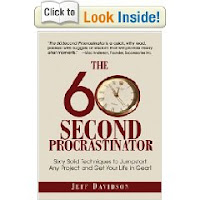
I pulled out a promising title: The 60 Second Procrastinator: Sixty Solid Techniques to Jump-Start Any Project and Get Your Life in Gear! by Jeff Davidson. The back of the book claims that “you can bust procrastination in one minute flat!” It’s a little book, but judging by the turned-down corners and the colored sticky tabs poking out from its pages, it is full of great ideas I’ve used in the past!

The author says “procrastination is a nasty habit and facilitated by distractions.” No argument there! Mr. Davidson also says: “Whenever you let progress on lower-level tasks or projects stand in the way of higher-level tasks or projects, you are procrastinating–you got that? Procrastination…is a recurring response to all that is competing for your attention.”

Lower level tasks? Yard work, email, lunch out, my favorite mystery. Higher level tasks? Writing, marketing, researching, attending critique group. But how do we shift our priorities to those “higher level” tasks?

Tried and True

Time for some of those one-minute solutions! I turned to the first dog-eared page, then the next, then the next. I remembered these ideas! They were simple–but they worked for me.

While it was tempting to procrastinate and read all sixty of the procrastination-busting techniques, I stopped after three. I put them into practice instead. And wrote. Happily.

What about you? Do you have one “tried and true” technique you could share?

Getting Your Ducks in a Row: Organization or Procrastination?

Some time ago one of Suzanne Lieurance’s email “Morning Nudges” hit me between the eyes, and I printed it out as a reminder.

I see this week that I need the same nudge again.

Maybe you do too.

Ducks on Parade

“People will tell you that before you start on any new venture it’s a good idea to get all your ducks in a row,” Suzanne said. “And that is good advice. However, have you ever known people who spend ALL their time getting their ducks in a row? Heck, they spend so much time doing this, they end up getting OTHER people’s ducks in a row, too. It’s as if they feel they’ll never be ready to start something new, something really BIG, something wonderful! They need to spend just a bit more time getting those ducks in a row, and THEN they’ll be ready. Yet, that time just never seems to come.”

Does that describe you? Sometimes it describes me.

Ducks Out of Control

Like these past months…I met two nonfiction book deadlines, finished a novel rough draft, taught a workshop, and did several critiques. Now I’m facing a massive revision of a novel that grew all out of proportion. I hardly know where to start. So in order to clear the decks for some serious writing, I decided to take a week to get all my miscellaneous ducks in a row.

I had a marketing duck, a website update duck, a critique duck, a newsletter, and a research duck. (I also had several grandchild visits–very cute ducklings.) The writing ducks popped out of line repeatedly, but after fifty hours I got them lined up.

And now I’m facing next Monday with no excuses. The ducks are in a row. There is time to write. Now what? I find myself noticing other little ducks  swimming out of line. (e.g. I really should clean my office first because I work much better in a clean office. I really should go to the gym for my stiff back and the eye doctor for new computer glasses. I really should visit the scene of my novel again and take better photos. So many ducks–so little time!)

The Procrastination Duck

I’m sure you know where I’m going with this. Yes, it’s important to get your ducks in a row. You don’t want to dive into a project half prepared. You waste precious time that way–and turn out shoddy writing.

But when does organizing cross the line into procrastination? There’s a point where we’re just putting off the inevitable–that blank page or revision that panics us. Only you can tell for yourself. What signs let you know that you’re crossing the line–and it’s time to bite the bullet?

Quack, Quack!

Before we can sit down and write, we all have certain ducks we need to have lined up. For some, it’s a super clean desk. For others, it’s doing the dishes and starting the laundry. For still others, it’s certain rituals that need to be in place.

At what point, though, do you tell yourself that “enough is enough”? I’d love to hear what works for you!

Five Stages of Procrastination

How is procrastination like a bridge you set on fire yourself? According to Neil Fiore in The Now Habit, it’s similar to a situation where we scare ourselves into being frozen.

Fiore says to imagine a very long flat board on the ground in front of you, and then imagine walking on it to the other end of the board. Piece of cake, right?

Then he says imagine raising that board 100 feet off the ground, reaching from one tall building to another. Imagine walking across it again. You don’t skip light-heartedly across now, do you? You worry about falling to your death–and you don’t even take one step.

Then, in the third scenario, he says to imagine you smell smoke and feel heat on your back. You turn, and the building you stand on is in flames. You’ll die if you don’t get moving. What do you do now? Without even thinking, you get across that board. You might crawl, you might sit down and scooch across, but you get across to avoid being burned to a crisp.

That’s procrastination in a nutshell. Here’s how:

Five Predictable Stages

  1. You let a task determine your self-worth. You think being successful at this writing task or goal will make you happy. You think your self-worth as a writer is wrapped up in this project.
  2. You use perfectionism to raise the task 100 feet above the ground–like the imaginary board above. “You demand that you do it perfectly–without anxiety, with complete acceptance from your audience, with no criticism,” says Fiore.
  3. You find yourself frozen with anxiety. Your imaginary difficulties with the project raise your stress level. Adrenaline kicks in. You seek temporary relief.
  4. You use procrastination to escape your self-created dilemma. This brings the deadline closer and creates more pressure. You delay starting so long that you can’t really be tested on your actual writing ability (what you are capable of if you’d started sooner).
  5. You use a real threat to jar you loose from the perfectionism and motivate yourself to begin. The deadline, fast approaching, acts as the fire in the building in the opening example. It forces you to get moving and actually begin the writing.

 Breaking the Cycle

The author of this terrific book then takes you back to the top of that building and asks you to imagine still being frozen as you face walking across that board. Then he says to imagine NO fire, but instead a strong, supportive net just three feet beneath the board. It stretches all the way to the other building. There is no danger.

How do you create such a writing safety net? His suggestions in the remainder of the book show you how. Stay tuned for some ideas that work!

Finding Writing Freedom

Within the last month, I’ve switched over from XP to a Windows 8 laptop with wireless Internet. It has been a wonderful, eye-opening change!

YouTube videos and movies no longer stick, break up, or freeze. I can access the Internet in any room of the house—or even when away on trips. I can check frequently on Facebook to see new videos and photos of my beautiful grandkids. And I could decide to answer “just one more email question” before going to bed.

Therein lies the problem.

Addicted? Who, Me?

I never had a tremendous amount of sympathy for writers who couldn’t seem to stay off the Internet long enough to get their reading, writing, and studying done. How hard could it be really? Well, this past month I found that it’s a lot harder to leave alone than I thought! Having dinosaur dial-up and then a pokey DSL line had been my biggest productivity friend, I think.

While I love the new computer—and it would have been so welcome when writing a couple of nonfiction books that required much research—its high-tech capabilities are causing trouble.

Enter Freedom!

I don’t know about you, but I don’t have so much willpower to spare that I want to spend it fighting the Internet. And yet computers—with Internet access—are here to stay. So I did what my youngest daughter grilled into my head. Her answer to everything is “Google it!” So I did.

And I found a fabulous “block the Internet” download called Freedom. For a mere ten dollars (and there’s a free trial if you’d like to try it first), you get instant willpower. It buys you freedom to focus by blocking your Internet access! You can set the “block” for any amount of time, from fifteen minutes to 24 hours. You can set schedules for different days of the week if you like, and then you write.

I love the app. I would pay more for it, if necessary. (And I don’t part with my money easily!) I noticed this morning as I set the timer (on both my computers) for three hours of blocking, there was a wonderful sense of peace. There wasn’t the withdrawal I expected. Instead—and this will sound so anti-social—there was such a feeling of “no one can get to me for three hours—it’s my time to just write!”

And so I did.

Success!

Nothing makes us feel like writers more than writing. And nothing makes me feel like a successful writer more than having a very productive writing day. Freedom gives me that!

How about you? Do you need some writing freedom too? And do you have a favorite time-saving or willpower-producing tip?

Writers: Practice What You Preach

I got home late last night from the Highlights Foundation’s “Sharing Our Hope” workshop, where I did a lot of preaching about the importance of self-care for writers and how absolutely critical it is to our writing lives.

We had a marvelous time together and forged new friendships. Even so, after “giving out” for several days, I’m exhausted this morning and slightly under the weather.

Stop! Stop! Stop!

I started right in on my to-do list, which managed to grow considerably even when I was gone. But I felt over-whelmed. Then my own voice came back to me from a talk on Saturday on self-care for writers. The voice was clear: “Practice what you preach!”

So I read some of my own blog posts and reminded myself of a few things I already knew. Thanks to “Mood-Dependent Writing Stages,” I have decided to tackle some rote-writing and prewriting tasks that need to be done. They won’t require nearly so much psychic energy as what I had planned to do.

And after re-reading “Writer Diagnosis: Failure to Thrive,” I saw how I could get from “languishing” to “flourishing” today. I needed that middle step–nourishing–in a couple of different areas. I plan to actually DO them!

Do What You Already Know

I think today’s writers are some of the most educated writers ever seen. But we’re not especially good at doing what we know is the wisest thing to do.

I am guilty of that too frequently. At least for today, I’m going to change that! 

By any chance, is there some area of your writing life where you “know better,” but you also need to follow through? Be brave and leave a comment!

Writers: Choose Your Friends Wisely (Part 2)

[If you haven’t yet, read about the dangers of toxic “friends” in Part 1 of “Writers: Choose Your Friends Wisely.”]

Traits of a True Friend

So…what are the characteristics of friends who best nurture our creativity and productivity?

A. Supportive non-writer friends show an interest. They may not understand exactly what you do, but they ask about your current projects (as you ask about theirs). They’re happy for your successes, no matter how small in the world’s eyes.

B. Supportive writer friends pump you up to do your best work, and even act as cattle prods. (“Quit stalling. Sign up for that conference.”) The encouragement of your peers is special. At one point, because of some health problems, I had virtually lost touch with my writer friends for over two years. Until I reconnected at a conference, I hadn’t realized what a grind my writing life had become. Just being together to “talk shop” reminded me that I was a writer. It rejuvenated my enthusiasm.

C. Friends in a working critique group can be a godsend. First, the members offer good constructive criticism to each other. Second, members hold each other accountable (in a kind way) for actually producing some material each week.

D. In a beneficial way, misery loves company! How much better I felt when I attended a retreat to discover that I wasn’t the only one whose books were going Out Of Print or who hadn’t signed a book contract all year. Instead of feeling like an abysmal failure, I then saw my experience as part of the general upheaval of the publishing world.

E. On a practical level, supportive writing friends often share valuable marketing tips (who’s looking for what genre, an agent’s advice about a hot topic). Alone, we writers have little “inside information”; collectively, we have a broader base of knowledge.

Finding Those Friends

If you need a change in the friendship area, don’t despair. You can find new supportive friends. As you nurture your writing life and grow in self-confidence, you’ll attract friends (writer and non-writer alike) who are more supportive as well.

We often have to believe in ourselves before anyone else does. Others often take their cues from us. So learn to be your own best friend first!