Jane Austen and Me

I got some news last Tuesday that took my breath away.

In the past two years, I’ve written (among other things) four mysteries for adults. Three were part of a historical series. One novel featured Jane Austen.

This week I got an email from a woman in charge of collections at the Jane Austen House Museum in Chawton, England.

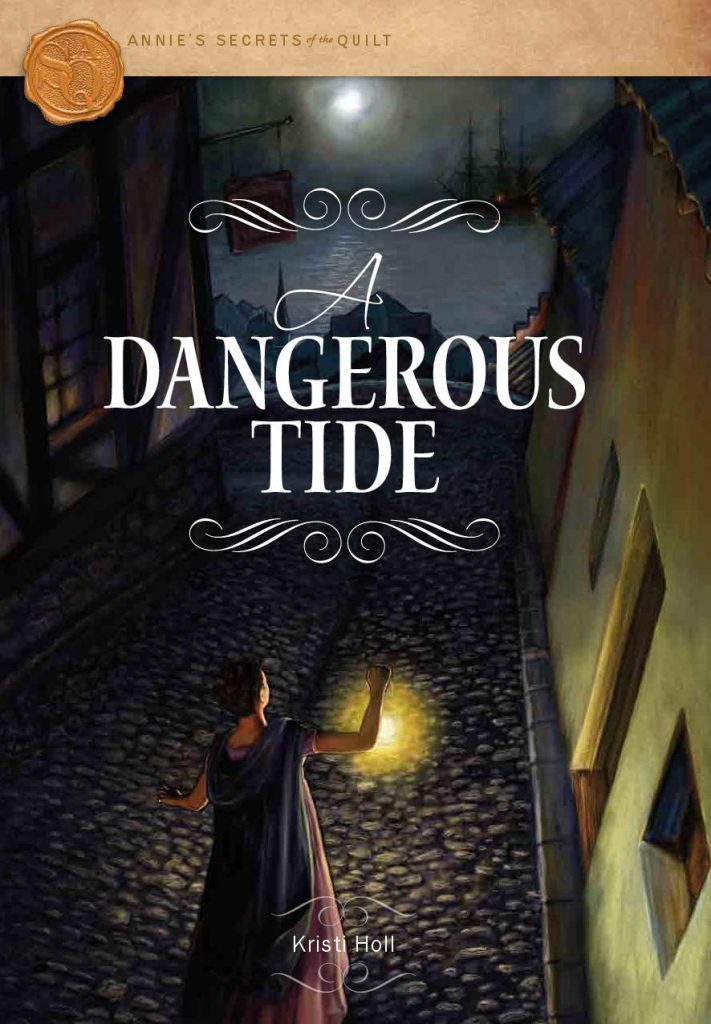
It was about my Austen novel, A Dangerous Tide, and her decision to add it to the museum’s Reading Room.

Felt Like a Dream

Sue Dell, from the museum, said the following: “Having reviewed your book we have decided we will place your book on our public shelves in the Reading Room at Jane Austen’s House. It will remain on the shelves for 12 months. We like to show the public that Jane still inspires writers today, and your story is a lovely example of this.”
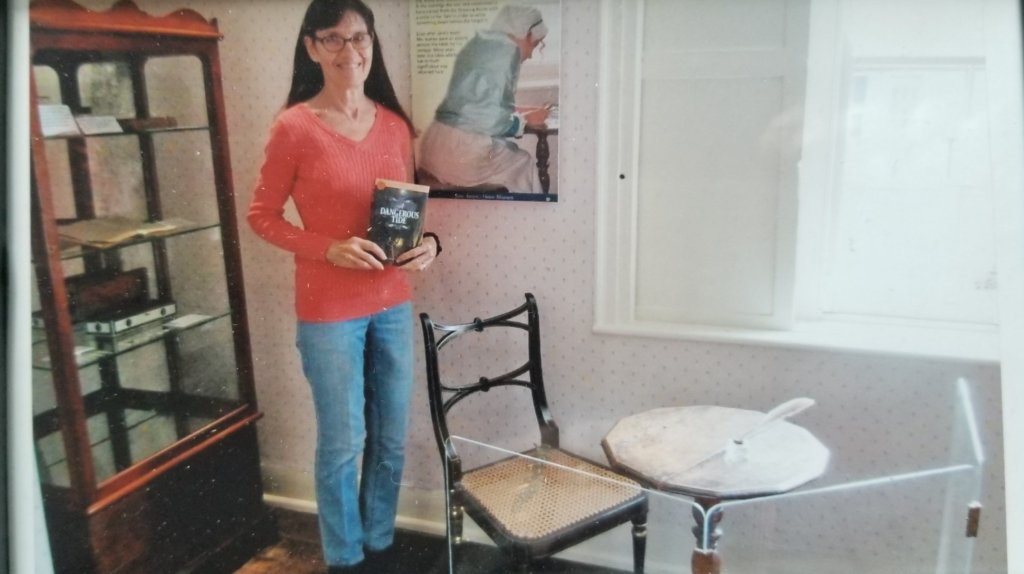
I read the email several times before it sank in. My novel featuring my all-time favorite author, Jane Austen, is sitting on a shelf in Jane’s house in England, just down the short hallway from the dining room where Jane sat at her tiny, twelve-sided table and wrote Pride and Prejudice,Sense and Sensibility, and others.

I was more thrilled by her email–and my book being placed in their Reading Room–than any award I ever received for a book.


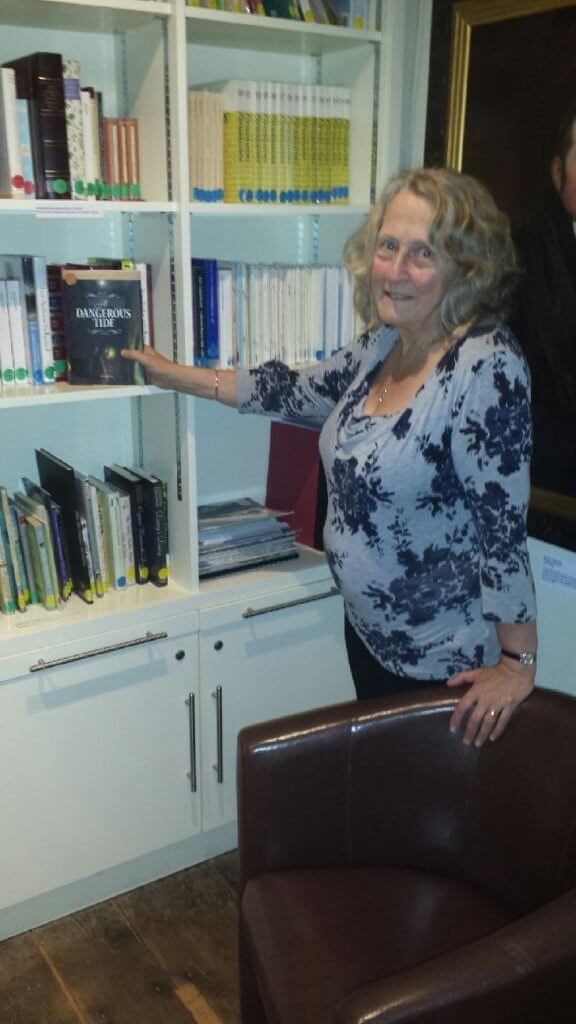
Below is a photo of one side of the reading room, and the other photo shows Sue Dell adding A Dangerous Tide to the shelves. [And below that, I’ll share a dozen photos of places in Jane’s house that appear in the book.]

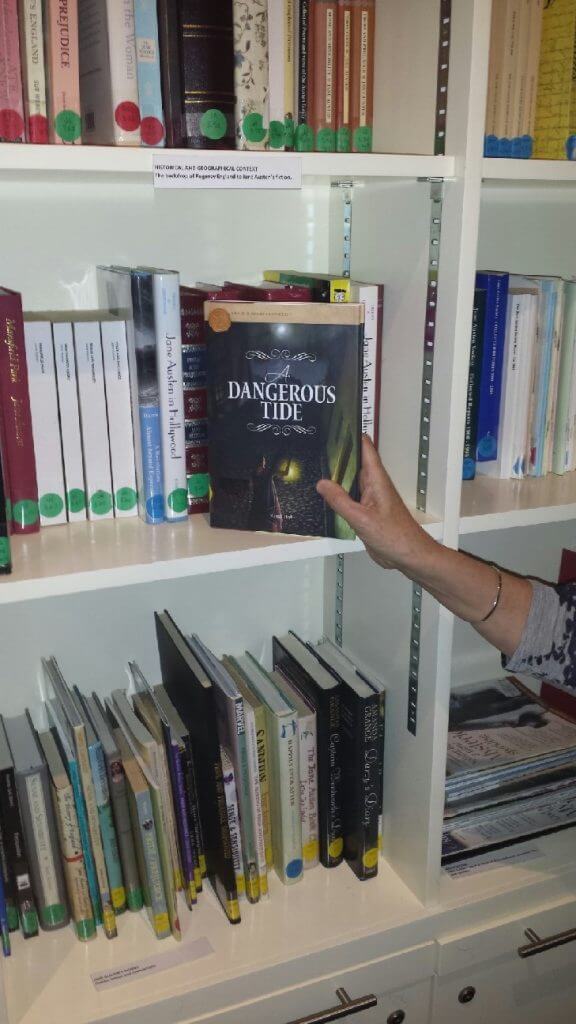
Jane Austen House Museum Reading Room


Sue Dell, Collections Volunteer

The Fun of Onsite Research

The events in the book were purely fictional, but the historical setting is accurate, the historical events of the time are real, and the Austen family is based on a lot of research done over the years of enjoying her books and movies and biographies.

For those of you who subscribe to the series (and for my friends who’ve read the book), I thought I’d share some photos of my trip to Jane’s house last September. I have included photos of places featured in the book’s story.

In no particular order then…

Jane Austen House Museum, Chawton, England
Jane’s pony cart
outdoor bakehouse
kitchen hearth
Jane’s upstairs bedroom overlooking court
seeing Jane’s view from her bedroom window
courtyard below Jane’s bedroom; bakehouse opposite
relaxing in the Austen garden


Beware! Burnout Ahead

“Writing is not everything,” says Lisa Shearin in Writer Magazine. “And if you want longevity in this business, play isn’t just important–it’s critical. We get so intensely focused on having achieved the dream and working so hard to keep the dream going, that we’re blind to the signs that if we keep going down that road at a fast pace, that dream could quickly turn into a nightmare.”

Recipe for Burnout

I was very glad to read her opinion piece–and I wish that message was published more often. I wish someone had said it to me years ago. Having a healthy drive is good, but letting yourself be driven–by others or your own inner critic or even your perceived budget needs–will eventually ruin the joy you originally brought to your writing.

“Dreams are meant to be savored and enjoyed,” Shearin says. “You do have to work hard, but sometimes, the work can wait.”

Too Late

Great advice, but what if you’re already burned out? What if–from overwork, juggling too many jobs and family members, a major loss, or chronic illness–your ideas have dried up? I’ve been there twice (previously) in my writing life, and it was a scary place to be.

Peggy Simson Curry spoke about this in a Writer Magazine archive article first published in 1967. She detailed the process she followed to “slowly work [her] way back to writing” and discover what had killed her creative urge in the first place.

Face the Fear

I think most writers would agree with Peggy that fear is at the basis of being unable to write–fear that a writer can’t write anything worth publishing. Burned out writers constantly think of writing something that will sell

“This insidious thinking,” Curry says, “persuades the writer to question every story idea that comes to him. He no longer becomes excited with glimpses of theme, characters, setting, threads of plot. He can only ask desperately, ‘But who will want it?'”

Healing Choices

Among other suggestions, this writer said it was very important to deliberately get outside, away from the writing, and just enjoy the world around you. In other words, play.

Coming out of burnout can be done, but it often takes methodical, small daily disciplines to do it. For me lately, it’s been watering the tiny vegetable garden my granddaughters helped plant and walking to a nearby pond to watch the turtles (doing nothing) and walk back. Earlier, when my eyesight was better at night, I stitched small quilted wall hangings, and that finally unclogged my creativity. Things that help will be different for each writer. 

I feel the burnout lifting lately. I still tire more quickly, but a little trip to the pond and back seems to revive me and restore that “want to” so important in writing stories. This time, I am determined to keep up the routine, even when I feel better, and avoid the burnout path in the future. It takes less time–and is more FUN–to do these routines when you already feel well than to do twice as much to regain your failing health (mental and/or physical).

So take time for yourself today, even ten minutes here and there. You’ll be so glad that you did!

The Gift of Time

It isn’t my birthday or Christmas or Mother’s Day, but it feels like it today. Why? Because I’ve decided to give myself a wonderful gift now.

The gift of time.

I’ve been writing and publishing since my kids were babies. They’re in their thirties now, with their own children ranging from toddlers to teenagers. During many of my children’s growing-up years, I was either single parenting or the family relied heavily on my income. Slowing down to study my craft was a dream I put on my yearly goals list, but it was rarely an option. The 50+ hours of work per week needed to generate income: writing books, teaching writing, speaking, writing test questions, and doing private critiques.

Always Running, Faster, FASTER!

Whenever I thought about studying more, reading more, taking more time to grow as a writer (versus making every hour a billable hour), I would promise myself, Later, when things slow down and the cash flow eases up.

Even when that day came where I could cut back, I found that the very idea panicked me. I had drummed into my head for so many years that freelancer warning, “If you don’t work, you don’t eat.” You learn to go without paid sick days or paid vacations–let alone time to study one’s craft.

If Not NOW, When?

For several years, I’ve been having a discussion with a dear writing friend about slowing down and spending time to improve our writing. I took motivational workshops, learned how to “work smarter, not harder,” streamlined my work habits, and multi-tasked until I met myself coming and going. And what did I do with the time freed up by all this smarter working? Took on more projects, learned how to blog, Facebook and Twitter…but rarely studied. Oh, I bought craft books, but the books that got my full attention seemed to focus on time management.

And my friend? Except for having grandchildren, she was as busy as I was. Yet she got her MFA in children’s writing (traveling half-way around the world to do it), and is now working on her Ph.D. While I don’t have the money for either of those things, I could certainly be studying more. And that’s where I decided to apply my gift of time.

Spending Vs. Investing Time

Starting today, I am giving myself the gift of time to study. I think if I do four or five hours of writing (the moneymaking activities) in the morning, then I could surely study for an hour every afternoon. To survive in the changing publishing times, we will all need to become better writers. And if not now, when? (By the way, it isn’t something I feel I should do. It’s something I want to do. I honestly do love to study.)

Maybe you can’t afford to work part-time yet. (I’m not positive that I can either. I’ll find out!) I know that situation is a reality for many of us. But if you can squeeze out even a daily hour to read current books in your field and study a writing craft book, I encourage you to do it. I’ve signed up for a writing course online which takes an hour per day, and I can’t wait to be a student again! It’s my gift to me.

How the Chunky Method Saved My Life

A couple of months ago, after being sick and traveling and meeting two book deadlines, I stalled when given some unwelcome health news which required tests and more tests. I got really, really behind on an adult mystery, and for hours I would struggle to write, only to throw it all out at the end of the day.

I was used to writing in 90-minute or two-hour blocks, taking a break, then doing it all again. I’d used that schedule for years, since I no longer have small children living with me. But sickness and burn-out had taken their toll, and I wouldn’t make my deadline at the rate I was going.

Enter the Chunky Method!

I had signed up to attend a Saturday writing workshop, and I was eager to be around other writers t. The speaker, Allie Pleiter, was to talk about her book, The Chunky Method Handbook: Your Step-By-Step Plan to Write That Book Even When Life Gets in the Way. To be honest, I didn’t expect to learn anything really new. I just wanted to be encouraged.

I got so much more!

In a Nutshell

Based on our personalities, our lifestyles, our season of life (small children, day job, retired empty nester) and our health, we all write in different “chunks.” By Allie’s definition, a chunk of writing is what you can comfortably do in one sitting, stopping when you pass the point of “this writing is good” into “the writing I’m doing now will have to be tossed out because it stinks.” She had a test for determining the length of your natural chunk. Big and little chunks are equally valuable.

Frankly, I was going to skip the test when I got home and move on to the rest of her book. I had to get busy! Anyway, my natural chunk for years had been about 90 minutes, or about 1500 words. I knew that already. But was it anymore? My writing life was certainly no longer working.

Back to the Drawing Board

I decided to do the chunky test. (You’re supposed to do this five days in a row, one chunk per day.) I didn’t have five days to use for this, so I did four chunks spread throughout a day. I was careful to stop when I felt too tired to keep going productively. Big discovery!

My chunk had shrunk!

I wasn’t able to comfortably write 1500 words at a sitting. My four chunks averaged only 500 words, and my sitting was only 45 minutes. At first I was really dismayed. I was too far behind to write the novel in 500-word chunks. Or so I thought.

I had nothing to lose by trying this method of writing my “comfortable chunk,” then resting a good while, then doing another “comfortable chunk,” and so on throughout the day.

Changing It Up

It worked! Before the Chunky Method workshop, my struggles had only produced about 1200 words per day, and sometimes not that much. Using the Chunky Method, I was able to average about 5,000 words per day rough draft, and some days nearly 8,000 words. And with the rest breaks between the chunks, where I walked or just went outside, I wasn’t stiff and sore or even very tired in the evenings. [NOTE: Determining your “chunk” is just the first step in the Chunky Method. I would tell you more, but I don’t want to plagiarize her book.]

Because I was writing so close to the deadline, I followed my own advice and got a paid critique from a writer I know and trust who has written award-winning mysteries. (Thank you, Mary Blount Christian!) After revising according to her excellent critique, I was able to turn in the manuscript on time. (And very little revision was requested by the editor this time too.)

So, in case you’re stuck, or you’re trying to write in the midst of stressful circumstances, I’d encourage you to buy The Chunky Method. It could change your writing life. It sure did mine!

Resting and Reflecting Before Re-Aligning

Since I last posted regularly, I’ve written three books (two adult mysteries and one juvenile nonfiction book), traveled, and been sick. The holidays blurred by, to be honest, because one of the book deadlines was December 20th. Two days ago I finished the second adult mystery.

One good thing about being sick is all the time you’re forced to be still: in waiting rooms, in recovery at home, in the night. Quiet time. Thinking time. Evaluating time.

HIATUS

What should happen when you take a hiatus from your regular life? [Hiatus = time off.] Among other things, I disappeared from my blog, newsletter and social media. I dropped out of several things at church for a while, and–this was the hardest–had to say ‘no’ a lot to my girls regarding babysitting my grandchildren.

An article, sustainable trauma recovery: taking a hiatus boosts MOTIVATION, by Robyn Mourning explains a healing process well. Her three-point recovery plan included rest, reflection, and getting re-aligned. A hiatus can be months away from your normal routine, or a week off, a weekend, half a day, or an hour long.

How should you spend your hiatus, if you want to feel the full benefits?

REST

Rest: take a breather, relax, stretch, just be.

At first, this was all I could do. I sat…on the couch, in bed with a book, in the backyard swing, down the trail by the pond. I wasn’t even thinking much. Not reading either. Catatonic mostly. Sometimes I walked rather zombie-like, appalled at how winded I was just walking! (I won a 5K race in my age group two years ago.) The walking and stretching helped get rid of the headaches and backaches from sitting too long. Being in nature is also very healing for me.

REFLECT

Reflect: become aware of your progress, what you’ve done so far, notice any big or small shifts that are providing hope and fostering resiliency.

I knew I was making progress when I wanted to read again and could focus and stay awake to read. I had a stack of fiction books (over 20) and nonfiction books (25) that had piled up this past year, unread. I also began to reflect on how I had managed to get myself into such a situation so that I didn’t repeat it.

Most of the problem was that I had scheduled myself with no margin at all last year. If NOTHING extra had come up, there wouldn’t have been a problem. But lots of extra things did occur, and being sick so often wasn’t on my calendar either. It was one of those “life happens when you’ve made other plans” kind of years. No one’s fault. My planning wasn’t wrong, but it had been unwise in the extreme not to build in any margin.

RE-ALIGN

Re-align: get re-aligned (or strengthen your alignment) with your unique purpose, your values, your goals.

Upon resting and reflecting, I realized there were a few important things I had let go of when things got so busy. One was proper exercise and sleep. One was time with friends. Another included a couple family members I lost touch with. So it was then time to re-align. I used a couple of tools for this.

One tool was the book Living Forward by Michael Hyatt and Daniel Harkavy, which is new. It came with many, many free online resources, including an excellent test which shows what parts of your life are working well–and which parts you’re drifting in, just trying to keep your head above water without being sucked down by the undertow. It pinpointed two more places I’d let slide without realizing it. Doing the Life Plan has helped me get my values re-aligned with how I spend my time.

The other book that is helping me get re-aligned is When the Body Says NO: Exploring the Stress-Disease Connection by Gabor Mate, M.D. It has been eye-opening, not at all what I expected. I’m still learning from this one.

REST. REFLECT. RE-ALIGN. You’ll be glad you did. 

Just Keep Showing Up

This quote is from one of my favorite authors, Henry Cloud, co-author of the Boundaries books.

The last few months have been challenging, and I’m behind where I wanted to be on a deadline. So this quote is appropriate today.

I won’t obsess about the deadline. I will show up at my desk early every day to plant, water, weed, and nurture this plot.

Fruit will grow!


The Power of Intermittent Recovery

HAPPY NEW YEAR!

From the book The Power of Full Engagement:

To be an effective energy manager, you need to spend nearly all of your time fully engaged in the high positive energy quadrant or recovering your energy by spending time doing things in the low positive energy quadrant.

Definition of Terms

The low positive energy quadrant consists of doing activities that leave you relaxed, mellow, peaceful, tranquil and serene. For me, that means reading a good book or watching a good movie or spending time with certain people with whom I’m on the same sympathetic wavelength.

For you, such positive-energy producing activities may include fishing, golf, sitting in your porch swing, listening to music, going for a bike ride or stroll, or any number of things. The important point is this: unless you spend sufficient short periods throughout your day in intermittent recovery, you’ll burn out and experience a host of other unpleasant symptoms.

Is It Really That Important?

Yes, if you spend all day writing furiously on your novel, zipping along in your high energy positive quadrant, you’ll produce an amazing amount of work. That day, anyway. Maybe even two days in a row, but that will be it.

By relentlessly spending mental energy without recovery, you’ll be tired, anxious, irritable—and self-doubt will inevitably set in. In a tired state, our stories stink, our ideas sound hackneyed, and our prose deadly dull. At that point, we end up taking off more time from the writing than we would have if we’d made ourselves take those intermittent breaks throughout the writing day. (Trust me on this. I speak from experience.)

The Pay-Off

What’s the result of taking those short “low positive energy” recovery breaks? You’ll come back to your work more energized, less ache-y in the neck and back, and more emotionally upbeat.

The emotional component is just as important as your physical energy level! Defusing the bombs of self-doubt and anxiety will help your writing as much as feeling re-energized. And in the end, you’ll write more, not less, by taking the short breaks throughout the day. This is one of my 2016 goals.

Now I think I’ll try it myself and step outside into the lovely Texas sunshine.

Striving for Contentment

Would you call yourself a contented writer? Are you happy with your current situation and writing progress?

Or are you a dissatisfied writer, striving to better yourself and always pushing hard toward your goals? It’s something we are faced with all the time, but especially at goal-setting time.

Embrace Opposite Traits

To be honest, if you want to enjoy the writing life–if you want to enjoy the process, and not just the final product–you’ll have to find a way to embrace both contentment and the urge to grow and  improve. Why? Because BOTH traits are important to your well-being as a writer and directly influence your career.

At Peace with Writing

First, you need to be grateful for what you’ve learned as a writer. If you’re a student, or you’ve been writing on your own for several months or years, take a look at your earliest stories and articles. You’ll groan, or maybe grin, at what you considered great writing back then. You’ll see how much you’ve learned about the craft of writing as well as the business of publishing. You can be grateful that your skills aren’t what they used to be!

Giving yourself credit for how far you’ve come is important in keeping your spirits up. We melancholy writers are too quick to get down on ourselves, our abilities, our ideas, and our publishing record. This critical mind of ours (so very valuable during the editing phase) can also be our greatest enemy if we don’t “think about what we’re thinking about.”

It’s probably true that you aren’t where you want to be as a writer (I’m not either!), but be thankful that you’re not back at the very beginning. Take note of your progress with writing skills, marketing skills, how deeply you read, your new blog, and how your lessons are improving. This is being content as a writer. “Whatever is true, whatever is right, whatever is excellent or praiseworthy, think on these things.” (Philippians 4:8) It will allow you to enjoy the writing process.

[Caution: don’t confuse being content with being complacent.  A complacent attitude says, “I’ve arrived. You can’t teach me anything. I’ve been there, done that, got the t-shirt. I can coast from now on.”  A complacent writer stops reading and studying and working at his craft the minute he emails his final lesson or makes his first big sale. Complacency keeps you stuck in one spot–and eventually you start sliding backwards.]

Striving to Grow

At the opposite end of the spectrum is the desire to mature in your writing, and the inner gumption to press forward and make it happen. It’s enjoying your progress while at the same time moving forward to learn even more.

It’s being consistent in your learning curve. (By consistency, I mean devoting a certain amount of time almost daily to your writing growth. Maybe it’s thirty minutes of reading writers’ blogs or writing magazines. Maybe it’s studying a good writing craft book or taking an online class or webinar.)

Juggling Act

Like so many things in life, you have to find the balance here. You want to have enough “drive” to make steady progress in your career–but not end up “driven.” Trust me on this–“driven” is no fun. It comes with ulcers and headaches. On the other hand, you want to enjoy your writing life, and that means learning to be content in whatever stage you’re in. BUT you don’t want to be so content that you become complacent.

It sounds confusing, but it’s not really. Being happy with your writing while striving to learn and write better is akin to being in the zone for me. Slipping out of that zone, on either side, brings doubts and pressure. Pay attention to how you feel about your writing. Make course corrections, if necessary, to remain a happy writer.

Self-Care for Writers Series

If your year has included sickness and/or a lot of deadlines, and you’re dragging yourself into the New Year, I want to point you to a series on self-care for writers.

I am making self-care my “push goal” for 2016. (Michael Hyatt calls a push goal the one goal that, if you met it, would greatly impact all your other goals.) Recovered health will impact my new year more than anything else at this point.

Here is the series. As Cec Murphy says, it’s for writers who only write an hour or who write full-time. Enjoy! Take better care of yourself!

  • Self-Care for Writers Part 1
  • Self-Care Part 2
  • Self-Care Part 3
  • Self-Care Part 4
  • Self-Care Part 5
  • Self-Care Part 6
  • Self-Care Part 7
  • Self-Care Part 8 
  • Self-Care Part 9
  • Parts 10 and 11 are to come yet!